Home › NYC Parking Guide
2026 driver’s guide
NYC Parking Guide (2026): Rules, Meter Rates, Fines, and Garage Costs
Street rules, meter rates, tickets, towing, garage costs, and parking tax. Checked against NYC DOT, DOF, MTA, and NYS Tax sources.
✔ Last updated: October 9, 2026
Sources: NYC DOT · DOF · MTA · NYS Tax
Rechecked monthly
NYC Parking at a Glance
The numbers drivers ask about most, from official NYC sources. Meters are not in effect on Sundays or major legal holidays.
$1.50–$5.50
First-hour meter rate, by zone
$65
Street cleaning (ASP) ticket, citywide
$35–$65
Expired meter ticket (outside Manhattan / Manhattan at or below 96th St.)
$115
Fire hydrant ticket, within 15 feet
30 days
To request a hearing on a ticket
$185
NYPD tow fee (a boot for unpaid tickets is also $185)
18⅜%
Manhattan garage tax (10⅜% with the resident exemption)
$9
Peak congestion toll for cars at or below 60th St.
Parking in New York City comes down to four things: the sign, the meter, the ticket, and the garage. Misread a sign and you can pay $115 for a hydrant violation. Your car can also be towed. This guide explains all four in plain language. Fines, rates, tolls, and tax figures come from official sources, and we date each check.
Need a spot right now? Use our Find Parking NYC tool. Want the rules first? Keep reading.
How NYC Street Parking Works
The whole city is a tow-away zone under state law. Per NYC DOT, any illegally parked car may be towed. Missing or expired registration or inspection stickers can also get you towed.
How to Read a Parking Sign
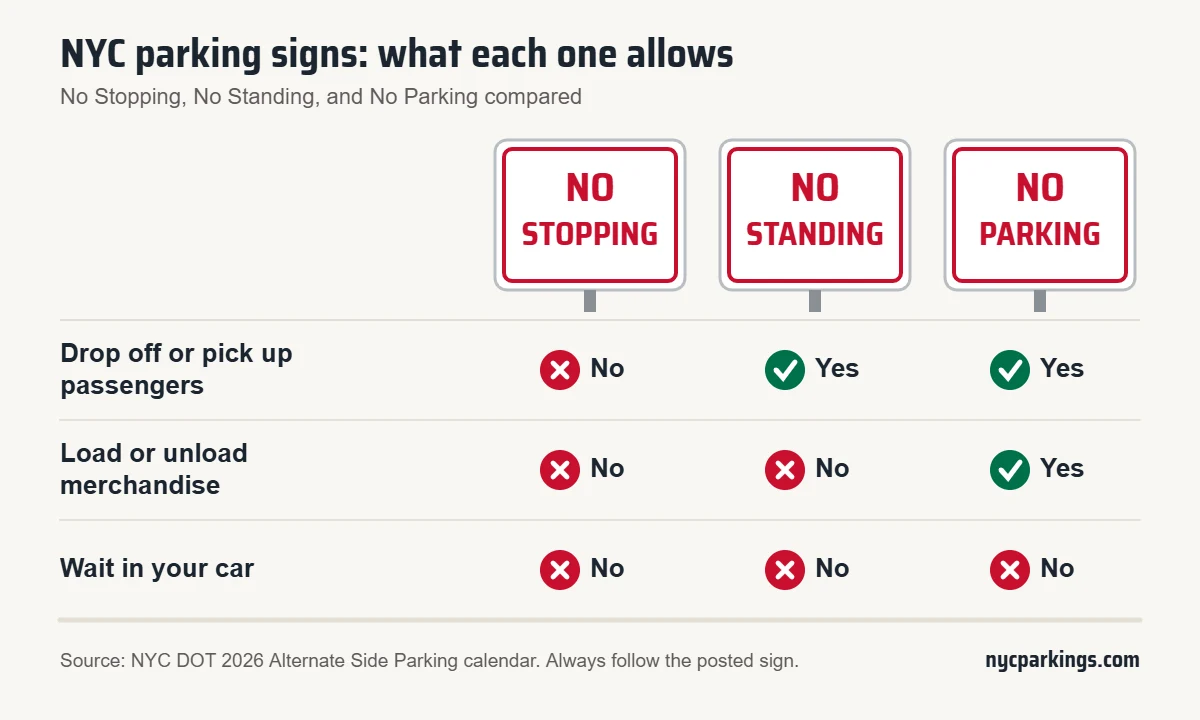
Three signs cause most of the confusion.
| Sign | What it allows | What it bans |
|---|---|---|
| No Parking | Stopping while actually loading or unloading merchandise or passengers | Leaving your car |
| No Standing | Quick passenger drop-off or pick-up | Waiting, or stopping to load packages or merchandise |
| No Stopping | Nothing, apart from emergencies or police direction | Stopping for any reason, including drop-offs |
City rules define “standing” as stopping a vehicle, occupied or not, other than temporarily to receive or discharge passengers.
Read every sign on the pole. Construction can bring temporary signs with different rules, and arrows show which direction a rule applies. A broom symbol means street cleaning rules apply.
Look Up Any Block With DOT’s Parking Sign Locator
DOT offers a map that shows the rules on street cleaning signs for specific streets. You can reach it at nyc.gov/dot/parkingrules. Check it before you leave home.
Myth buster
The painted curb myth
Painted curbs near hydrants do not show where you can park. The rule is 15 feet on either side of a hydrant, and painted curbs don’t mark that distance. Measure it yourself, and see our full guide to fire hydrant tickets in NYC for the daylight exception and how the $115 fine can escalate.
Other Rules That Catch Drivers
- Crosswalks: A crosswalk exists even without paint, and blocking one costs $115.
- Driveways: Parking in front of a driveway costs $95.
- Pedestrian ramps: Blocking one costs $165.
- Double parking: The fine is $115, and in Midtown it is banned from 7 a.m. to 7 p.m., except Sundays.
How Locals Handle Street Cleaning
Locals plan around it. Many come back a few minutes before the posted end time to grab a spot. Some wait in their cars during the window. That is a gamble. DOT treats an occupied, illegally parked car the same as an empty one.
Don’t do this
Do not leave early. You can’t legally park until the posted end time, even after the sweeper passes. Do not double park to hold a spot either. That is a $115 ticket.
Alternate Side Parking, Explained Briefly
Alternate side parking (ASP) lets crews clean the streets. The city suspends ASP on specific legal and religious holidays, and during bad weather and emergencies. Missing it costs $65. In fiscal 2025, the city wrote about 1.8 million street cleaning tickets, per DOF’s annual report.
Which holidays suspend what?
| Situation | ASP | Meters |
|---|---|---|
| Major legal holiday | Suspended | Also suspended |
| Other holidays | Street cleaning only is suspended | Still in effect |
| Snow prep | Suspended | Still in effect |
The major legal holidays are New Year’s Day, Memorial Day, Independence Day, Labor Day, Thanksgiving, and Christmas.
After snow. DOT restores ASP after snowfall so plows can clear the curb lanes. In 2026, ASP returned in mid-February after a snow pause of nearly a month that began in late January.
Check today’s status. Use NYC 311, DOT email alerts, or the @NYCASP account on X. For the full 2026 suspension calendar, sign rules, and ticket help, read our alternate side parking NYC guide.
Meters, Rates, and How to Pay
Meter Rates by Zone (2026)
| Zone | Area | 1st hour | 2nd hour |
|---|---|---|---|
| M1 | Midtown Core, Lower Manhattan | $5.50 | $9.00 |
| M2 | Manhattan south of 96th Street | $5.00 | $8.25 |
| M3 | Manhattan, 96th to 110th Street | $3.00 | $5.00 |
| Zone 1 | Outer-borough business districts, Manhattan’s 125th Street | $2.50 | $5.00 |
| Zone 2 | Neighborhood retail districts, such as Williamsburg‘s commercial strips | $2.00 | $3.00 |
| Zone 3 | All other metered locations | $1.50 | $2.50 |
These are DOT’s posted rates for passenger vehicles. Commercial-vehicle meters in M1 and M2 cost more. Maximum stay ranges from one to 15 hours, depending on vehicle type. Always confirm the price on the meter. DOT also publishes rate zones on NYC Open Data.
Outdated info elsewhere
Some older guides still list $1 flat rates. Trust the table above.
Pay-by-Plate vs. Pay-and-Display
Meters are changing. DOT began replacing pay-and-display meters in Manhattan in May 2024, with the other boroughs following in fall 2025.
- Pay-by-plate: You enter your plate and state. You don’t need to leave a receipt on the dashboard.
- Pay-and-display: You still place the receipt on the driver’s side dashboard.
How to pay at a pay-by-plate meter:
- Press Start to wake the touchscreen.
- Enter your license plate and state.
- Choose a payment method.
- Select your length of stay.
- Confirm payment.
Meters take credit cards, coins (exact change), and the NYC Parking Card, plus Tap to Pay on the new meters.
Paying With ParkNYC
ParkNYC is the city’s official system for metered street parking and municipal lots. Create an account, pick your payment method, and enter the zone number. You can extend time from your phone, up to the allowed maximum.
Meter Rules That Trip Drivers Up
- Time doesn’t travel. Time bought on one block face doesn’t transfer to another.
- Meter and app are separate. You can’t extend a meter payment in the app, or the reverse.
- Small grace period. You get five minutes before and after the purchased time on meter receipts.
- Broken meter. If it’s the only meter on the block face, you can park up to the posted maximum without paying. If another working meter is on the same block face, use it. Report broken meters through 311.
Heads up
Don’t assume meters shut off at 7 p.m. Hours vary by block, so read the sign or meter.
Tickets and Fines
Common Parking Fines
Each fine includes a $15 state surcharge.
| Violation (DOF code) | Manhattan, 96th St. & below | All other areas |
|---|---|---|
| Street cleaning (21) | $65 | $65 |
| Meter overtime / no receipt (37–38) | $65 | $35 |
| General no parking (20) | $65 | $60 |
| General no standing (14) | $115 | $115 |
| Fire hydrant (40) | $115 | $115 |
| Double parking (46) | $115 | $115 |
| Crosswalk (50) | $115 | $115 |
| Sidewalk (51) | $115 | $115 |
| Bike lane (48) | $115 | $115 |
| Bus lane / bus stop (18, 19) | $115 | $115 |
| Blocking a driveway (98) | $95 | $95 |
| Pedestrian ramp (67) | $165 | $165 |
| Expired registration sticker (70) | $65 | $65 |
Source: NYC DOF violation code table, checked September 26, 2026. Amounts can change, so confirm on nyc.gov/finance.
Should You Pay or Dispute?
Decide fast. You must request a hearing within 30 days to avoid late penalties. If you do neither, the ticket goes into judgment at about 100 days.
Before you move your car:
- Take photos with the date and time. Show street names, signs, meters, and the building address.
- Measure any distance the ticket mentions.
- Get contact details from witnesses.
How to dispute:
- You can dispute online, in the NYC Pay or Dispute app, by mail, or in person.
- If you lose, you have 30 days to appeal. Consider paying first to avoid further penalties. You get a refund if you win.
- For a ticket already in judgment, you can request a hearing only within one year of when it went into judgment. You need a valid defense and a reason you didn’t respond earlier.
Your odds. In fiscal 2025, about 26% of violations that went to a hearing ended in a not-guilty decision, per DOF’s annual report. Sign errors happen too. DOF says a ticket may be dismissed if a required element is missing, illegible, or wrong.
Free help. The Parking Summons Advocate offers video appointments for document review and dispute guidance.
Scam alert
Watch for ticket scams
DOF warns about fake texts. Scammers send fraudulent “notices of default” that DOF and the state did not issue. Don’t scan the barcode. Don’t send money to anyone you don’t know.
Towing and Booting
There are two kinds of tow.
- NYPD tow. The NYPD can tow you anytime if you’re parked illegally or lack valid registration or insurance.
- Marshal or sheriff tow. This can follow a boot when you owe $350 or more in ticket or camera judgments. If you owe $2,500 or more, the car can be towed right away.
What It Costs
For an NYPD tow, DOF lists a $185 regular tow and a $370 heavy-duty tow. For cars booted since November 1, 2025, DOF lists a $185 boot fee. The marshal or sheriff fee is $95, plus 5% poundage. A marshal tow after a boot adds tow, dispatch, and storage fees. You still owe the tickets themselves.
How to Get Your Car Back
- Find out who towed it. Check the DOF towed-vehicle page.
- If the NYPD towed it, go to the tow pound in that borough. You must pay any judgment debt if you owe $101 or more, plus tow fees.
- Don’t pay the ticket at the pound. Pay or dispute the underlying ticket separately with DOF within 30 days.
- If a marshal or sheriff towed it, follow DOF’s towed vehicle steps. You must pay all judgment debt and fees first.
- Need your belongings? You can request a property release for items like luggage or a car seat. Non-owners need a notarized letter from the owner.
Garages, Monthly Parking, and Costs
Types of Garage Parking
- Hourly and daily. Best for short trips.
- Overnight. Often has strict drop-off and pick-up hours.
- Monthly. Best if you drive weekly.
- Valet. Common in Manhattan.
What It Costs
Prices swing widely by block, time of day, and demand. These are rough market ranges, not official city data. Use them only as a starting point.
| Parking type | Typical rate |
|---|---|
| Daytime / commuter | $20–$35 |
| Overnight | $37–$60 |
| Monthly (Manhattan average) | $500–$1,200+ |
| Monthly (Upper East / Upper West Side high end) | Up to $1,400 |
| Monthly (Brooklyn, Queens, the Bronx) | About $200–$500 |
| Cheapest listed hourly rates | Around $8 per hour at select garages |
Garage prices change often, and they are before tax. Confirm the rate with the operator before you go.
Questions to Ask Before You Book
- Height limit. Many garages post a maximum height. Tall SUVs, vans, and roof boxes may not fit.
- Vehicle fees. Some garages charge extra for oversized SUVs or electric vehicles.
- Overnight hours. Some garages require pick-up and drop-off within set hours.
- Valet-only. Travelers report many Manhattan garages are valet-only and that the ticket waives liability for contents. Leave nothing visible.
- Access. Ask about in-and-out privileges and 24/7 entry.
Don’t Skip City Lots
DOT runs municipal garages and lots in all five boroughs. They accept quarters, dollar coins, credit cards, and ParkNYC. Rates vary by facility. At DOT’s posted rates (effective October 1, 2024), Delancey and Essex in Manhattan charges $16 for the first hour, $50 for the daily maximum, and $600 for a monthly permit. Check DOT for current rates.
For monthly permits, DOT runs a reservation system.
- Reservations open five days before the first of the month at 10 a.m., first come, first served.
- A reservation doesn’t guarantee a permit. You must pay at the garage manager’s office by the first day of the permit month.
- Municipal fields don’t allow overnight parking.
Compare garages near your destination
Search NYC garage rates by neighborhood before you drive in.
Parking Tax and the Manhattan Resident Exemption
NYC charges tax on garage parking. The combined citywide rate is 10⅜%, from a 4% state tax, 6% city tax, and ⅜% commuter district tax. Manhattan adds 8%, for 18⅜%, unless the buyer is a certified exempt resident.
Who Qualifies
The exemption cuts the rate from 18.375% to 10.375%. The vehicle must be:
- Individually owned by the applicant.
- Registered to your primary residence in Manhattan.
- Parked in a long-term rented space, for one month or more.
- Used for personal purposes only. Commercial, rental, and company vehicles don’t qualify.
How to Apply and Renew
Apply through DOF, online or by form. Your garage operator can supply the facility number the application requires.
- Give the certificate to your garage. Payments made before you present it are not exempt, and DOF issues no refunds.
- Renew every two years. Submit your renewal by August 31.
- Report changes to your address, garage, or plate with a new application.
Example: $500 a Month
| Standard (18.375%) | With exemption (10.375%) | |
|---|---|---|
| Tax | $91.88 | $51.88 |
| Total | $591.88 | $551.88 |
Money saver
The exemption saves about $40 a month, or $480 a year. Misusing the certificate brings fines and penalties.
The Congestion Relief Zone and Your Parking Plan
The zone covers Manhattan south of and including 60th Street. Drivers who stay only on the FDR Drive, West Side Highway, or the Carey Tunnel connections to West Street pay nothing.
- Passenger cars with E-ZPass: $9 during peak and $2.25 overnight since January 5, 2025. That rises to $12 and $3 in 2028, and $15 and $3.75 from 2031.
- Once a day: The toll is charged once per day, however many times you enter.
- E-ZPass: Vehicles without E-ZPass are billed by mail at a higher rate.
Check before you drive
Legal status of the toll
In March 2026 a federal judge ruled that the federal government’s attempt to end the program was unlawful. The U.S. Department of Transportation appealed in May 2026, and the MTA is still collecting tolls while the appeal is pending. Check mta.info before you drive.
The toll is separate from your garage bill. If your stop is at or below 60th Street, compare parking a few blocks north or outside the zone plus transit, against a garage inside it plus the toll.
Driving Into NYC as a Visitor
Consider parking outside. All-day Manhattan garages are costly. Some visitors park near a commuter rail station and take the train in.
If you park in Manhattan:
- Reserve ahead. Garages near JFK, LaGuardia, Newark, Madison Square Garden and Yankee Stadium fill first on busy days.
- Check vehicle size rules before you book.
- Remove valuables. Tickets often carry a waiver of liability for contents.
Visitor checklist:
- Confirm height and vehicle-size limits.
- Ask about overnight hours.
- Save your confirmation and photo of your parked spot.
- Check the toll if you’re going at or below 60th Street.
Borough and Neighborhood Quick Guide
| Area | Meter zone (1st hour) |
|---|---|
| Midtown Core, Lower Manhattan | M1: $5.50 |
| Manhattan south of 96th Street | M2: $5.00 |
| Manhattan, 96th–110th Street | M3: $3.00 |
| Downtown Brooklyn, Downtown Flushing, Jamaica, Manhattan’s 125th Street | Zone 1: $2.50 |
| Neighborhood retail districts | Zone 2: $2.00 |
| All other metered areas | Zone 3: $1.50 |
Portions of Madison and Fifth Avenues north of East 96th Street, and Columbus Avenue and Broadway north of West 96th Street, fall in the south-of-96th rate area. Want rates for your exact block? Search by neighborhood.
What’s Changing in 2026
- Free curbside parking. Only about 80,000 of the city’s roughly three million curbside spaces are metered, per DOT. City Hall has discussed charging for more. The first deputy mayor said it deserves study but wouldn’t close the budget gap. We found no adopted change.
- Taxis and for-hire cars at commercial meters. DOT published a proposed rule on July 22, 2026, and held a public hearing on September 1. It carries out Local Law 24 of 2026. We found no final rule yet.
- Once-a-week street cleaning pilot. DSNY tested once-a-week cleaning on 12 Prospect Heights streets from August 3 to September 25, 2026. The pilot has ended. We have not seen published results yet, so follow the posted signs.
- New meters. Pay-by-plate installation continues across the boroughs.
- Congestion toll. See the legal note above.
We update this section monthly.
Best Parking Apps by Use
| You need to… | Try | Note |
|---|---|---|
| Pay a meter | ParkNYC | Official system for metered street parking and municipal lots |
| Find or reserve a garage | Find Parking NYC | Compare typical rates by neighborhood before you book |
| See street rules on a map | DOT Parking Sign Locator | The city’s official map of street-cleaning signs |
| Pay or dispute a ticket | NYC Pay or Dispute | The city’s official app |
| Check ASP status | NYC 311, @NYCASP | Official channels |
NYC Parking FAQ
Is parking free on Sundays in NYC?
Metered regulations are not in effect on Sundays or major legal holidays. Other rules can still apply, such as no standing or bus lanes. Always read the posted signs before you leave your car.
How much do parking meters cost in NYC?
The first hour runs from $1.50 to $5.50, depending on the zone. Midtown Core and Lower Manhattan cost the most. Outer-borough neighborhoods cost the least. Check the meter or the ParkNYC app for the exact price on your block.
How do I pay a NYC parking meter?
Use the ParkNYC app or pay at the meter. Meters take credit cards, coins with exact change, and the NYC Parking Card. At pay-by-plate meters, enter your plate and state. Newer meters need no dashboard receipt.
How long do I have to fight a parking ticket?
You must request a hearing within 30 days to avoid late penalties. You can dispute online, in the NYC Pay or Dispute app, by mail, or in person. Gather dated photos before you move your car.
Can NYC tow my car for parking tickets?
Yes. The NYPD can tow you anytime for illegal parking. A marshal or sheriff can tow after a boot when you owe $350 or more in violations in judgment. Pay or dispute tickets quickly.
What should I do if my car was towed?
Find out who towed it. If it was the NYPD, go to the borough tow pound. You’ll pay any judgment debt if you owe $101 or more, plus tow fees. Pay or dispute the ticket separately with DOF.
How far from a fire hydrant must I park?
The rule is 15 feet, and the ticket is $115. Painted curbs don’t show the limit. DOF allows passenger vehicles to stand beside a hydrant between sunrise and sunset only if the driver stays behind the wheel. Read our full breakdown of the 15-foot hydrant rule, including when you can legally wait in the car.
What’s the difference between No Standing, No Parking, and No Stopping?
No Parking allows stopping to load or unload merchandise or passengers. No Standing allows only passengers. No Stopping bans every stop. Read all signs on the pole, since rules can change by time of day.
Are meters free on all holidays?
No. Meters are suspended only on major legal holidays. On other holidays, only street cleaning rules are suspended. The six major legal holidays are New Year’s Day, Memorial Day, Independence Day, Labor Day, Thanksgiving, and Christmas.
How much is the Manhattan garage parking tax?
It’s 18⅜% unless you’re a certified exempt resident. The resident exemption lowers it to 10.375%. You must rent a long-term space for a personally owned vehicle registered in Manhattan.
Do I pay the congestion toll if I park in a garage?
The toll applies when you enter the zone, not when you park. It’s charged once per day. Passenger cars pay $9 at peak with E-ZPass. Your garage bill is a separate charge.
Can I use time from one meter on another block?
No. Time isn’t transferable between block faces. If you move your car, start a new payment. Meter and app payments also can’t be combined.
Not sure where to park?
Pick your neighborhood and see typical garage rates before you drive in.
How We Verify
We check fines, rates, tolls, and tax figures against official sources. We recheck them every month, and the update log shows the latest check. Read more about who we are.