
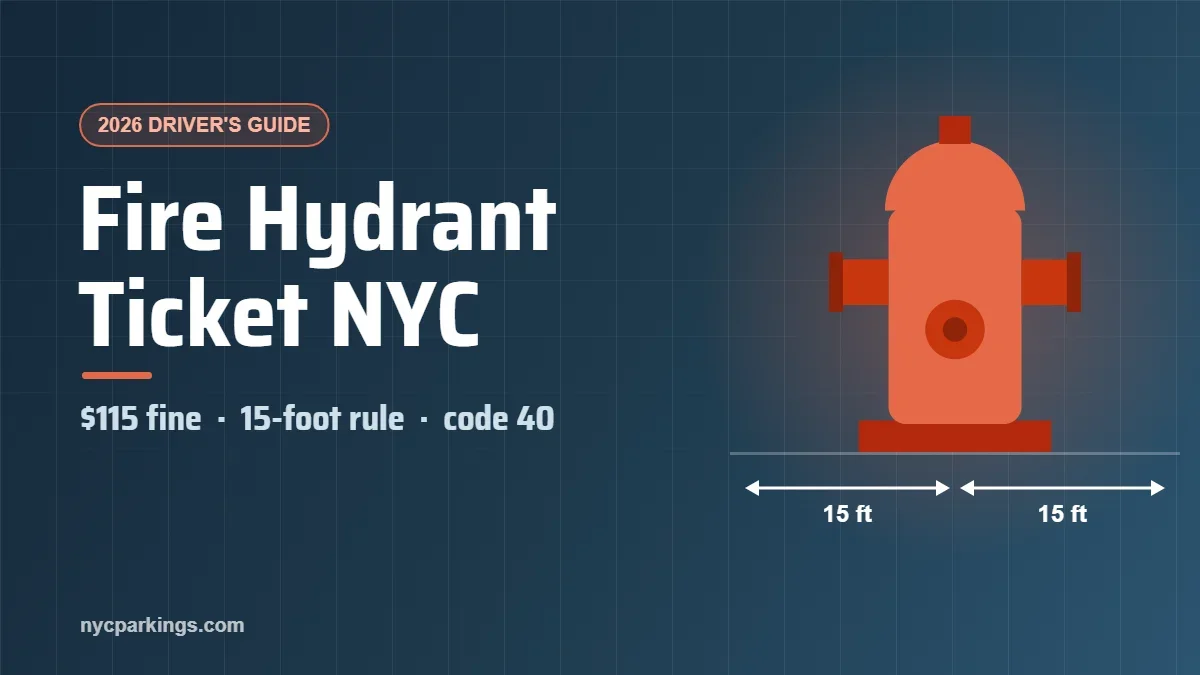
Fire Hydrant Ticket NYC: The 15-Foot Rule, the $115 Fine, and the New Fire Code Risk
On February 12, 2025, firefighters reached a burning Buddhist temple on Anthony Avenue in the Bronx. The closest hydrant was blocked by a parked car. Crews had to find another water source and stretch longer hose lines. Two people died in the fire, which was caused by a space heater. Three days earlier, two cars had blocked the two closest hydrants at a fatal fire in Bay Ridge, Brooklyn.
About two weeks after the Bronx fire, the FDNY fined the owner of the car blocking that hydrant $4,000. It was the first time the department had used the city’s fire code against a car blocking a hydrant. Before that, the usual penalty was a $115 ticket.
That ticket still ends almost every hydrant case. The NYPD wrote about 652,000 of them in fiscal 2024. This fire hydrant ticket NYC guide explains the rule behind it, the one narrow exception, what the ticket can turn into, and when it is worth fighting.
$115
Fine in every borough, violation code 40
15 ft
Clear curb needed on each side of a hydrant
30 days
To pay or request a hearing before penalties
$2,500–$4,000
FDNY fire code fines for blocking a hydrant at a fire
The short answer
Quick answer
A fire hydrant ticket in NYC costs $115 in every borough. It is Department of Finance violation code 40, for stopping, standing, or parking within 15 feet of a hydrant. The only exception lets a passenger car stand beside a hydrant between sunrise and sunset, while a licensed driver stays behind the wheel, ready to move.
| Item | What to know |
|---|---|
| Fine | $115 citywide, including a $15 New York State surcharge |
| Violation code | 40 |
| Distance | 15 feet on each side of the hydrant, about 30 feet of clear curb |
| When it applies | 24 hours a day, including Sundays, holidays, and alternate side suspension days |
| Exception | Daylight standing by a passenger car, licensed driver at the wheel |
| License points | None; it is a parking violation, not a moving violation |
| Deadline | 30 days to pay or request a hearing before penalties begin |
| Bigger risks | Towing; at an active fire, an FDNY fire code summons of $2,500 to $4,000 |
What the 15-foot rule actually says
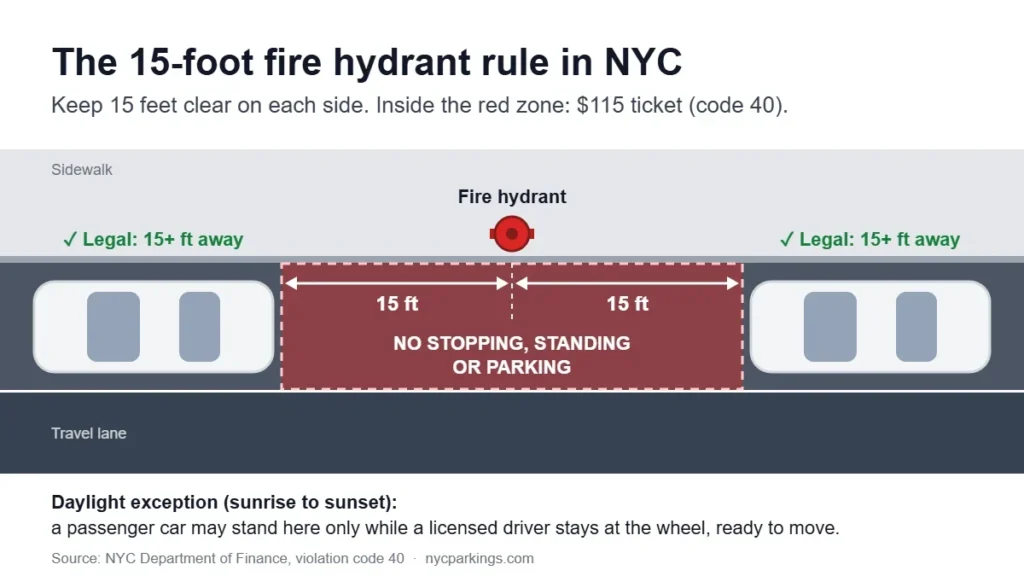
The rule lives in the city’s traffic rules, at 34 RCNY §4-08(e)(2). It bars stopping, standing, and parking within 15 feet of a fire hydrant, unless posted signs or parking meters indicate otherwise. The Department of Finance (DOF) enforces it as violation code 40.
The word “stopping” matters. It puts a hydrant in the same family as a No Stopping zone: even a short pause counts, not only a car left overnight.
The 15 feet runs in both directions. A car ahead of the hydrant and a car behind it each need their own gap, so about 30 feet of curb stays clear. The Department of Transportation (DOT) says the rule also covers floating parking lanes beside protected bike lanes.
Myth buster
Painted curbs don’t mark legal parking
Nothing has to mark the zone. The city needs no sign and no paint to write the ticket. Where you do see a painted curb near a hydrant, NYC311 warns that the paint does not show where you can legally park.
How to judge 15 feet at the curb
Fifteen feet is about 4.6 meters, or roughly the length of a midsize sedan. “Leave a full car length” is a decent rule of thumb, but it fails with a compact car or a tight block.
The city does not publish an official measuring point. The safe reading is to measure from the hydrant to the nearest part of your car, usually a bumper corner, and then leave a margin. If you are unsure, step it off or use a tape measure before you walk away.
The daylight exception, and why most drivers misread it
The rule has one exception, and it is narrower than its reputation. Between sunrise and sunset, a passenger car may stand alongside a hydrant as long as the driver stays behind the wheel, ready to move.
The full rule text adds three conditions. Standing must be allowed at that spot to begin with. The driver must start the engine on hearing fire apparatus approach. And the car must move at once when police, fire, or other city officials say so.
Notice what the rule does not require: an idling engine. It requires a licensed driver who is present and ready. That rules out several common habits:
Not covered by the exception
- Stepping out “for a minute.” Once you leave the seat, the car is parked, and the exception is gone.
- Leaving a passenger in charge. The person at the wheel must be a licensed driver, not a teenager or a friend without a license.
- Waiting after dark. The exception ends at sunset, whoever is in the car.
- Standing in a work van. The exception covers passenger vehicles only; commercial vehicles get no hydrant leeway.
Can I park here? 15 common situations
Most hydrant tickets start with a driver who thought their case was different. Here is how the rule applies to the situations people ask about most.
| Situation | Allowed? | Why |
|---|---|---|
| Licensed driver at the wheel, daytime | Yes if standing is allowed there | This is the daylight exception |
| Licensed driver at the wheel, after sunset | No | The exception ends at sunset |
| Engine off, licensed driver at the wheel, daytime | Yes | The rule asks you to start the engine when fire trucks approach, not to idle |
| Driver steps out briefly | No | The car is now parked |
| Unlicensed passenger left inside | No | A licensed driver must be at the wheel |
| Commercial van or truck | No | The exception covers passenger vehicles only |
| Alternate side parking is suspended | No | DOT reminds drivers that hydrant tickets are still issued |
| Sunday or holiday | No | The rule applies around the clock, every day |
| Floating parking lane beside a protected bike lane | No | DOT includes these lanes |
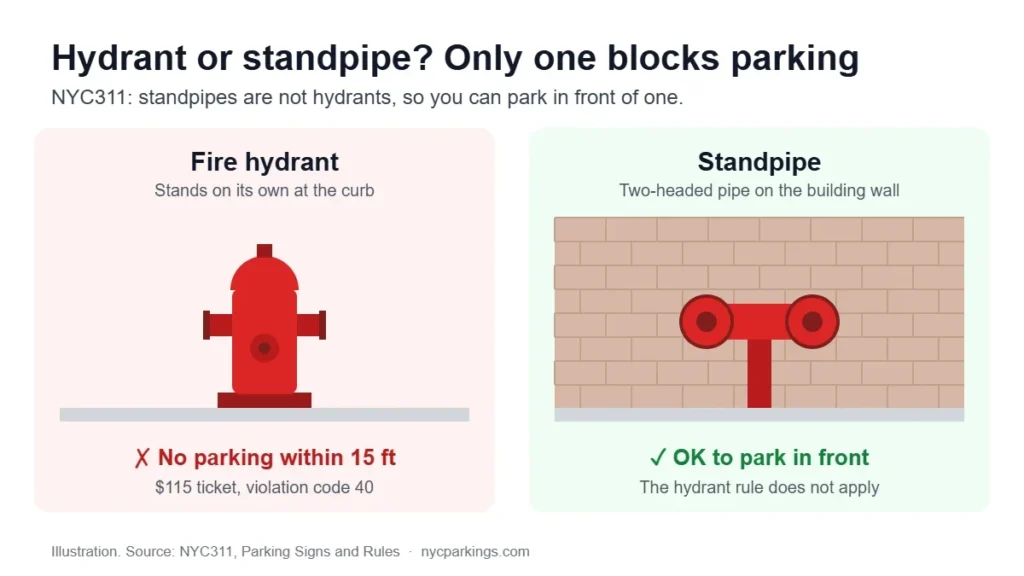
| In front of a standpipe | Yes | Standpipes are not hydrants |
| Painted curb ends short of 15 feet | No | Paint does not mark legal parking |
| Hydrant hidden by a fence, cone, or snowbank | No | A hidden hydrant still counts |
| A posted sign or meter authorizes the spot | Possibly | The rule allows it; photograph the sign or meter |
| NYC disability placard (NYC PPPD) | No | The placard does not cover hydrant zones |
| The rest of the block is parked that way | No | Each car can be ticketed |
A standpipe is the two-headed pipe on the front of many mid-rise and high-rise buildings. It is often red, which is why drivers confuse it with a hydrant. When a situation is not listed, use a simple test: if any part of the car is within 15 feet and no licensed driver is at the wheel in daylight, it is ticketable.
What a hydrant ticket costs, and what it can turn into
The $115 summons
The fine is $115 whether you parked in Midtown or on Staten Island. Meter and No Parking tickets cost less outside Manhattan, but code 40 has one price citywide. The amount includes a $15 New York State surcharge.
A hydrant ticket is a parking violation, not a moving violation. It adds no points to your license.
Late penalties, judgment, and the boot
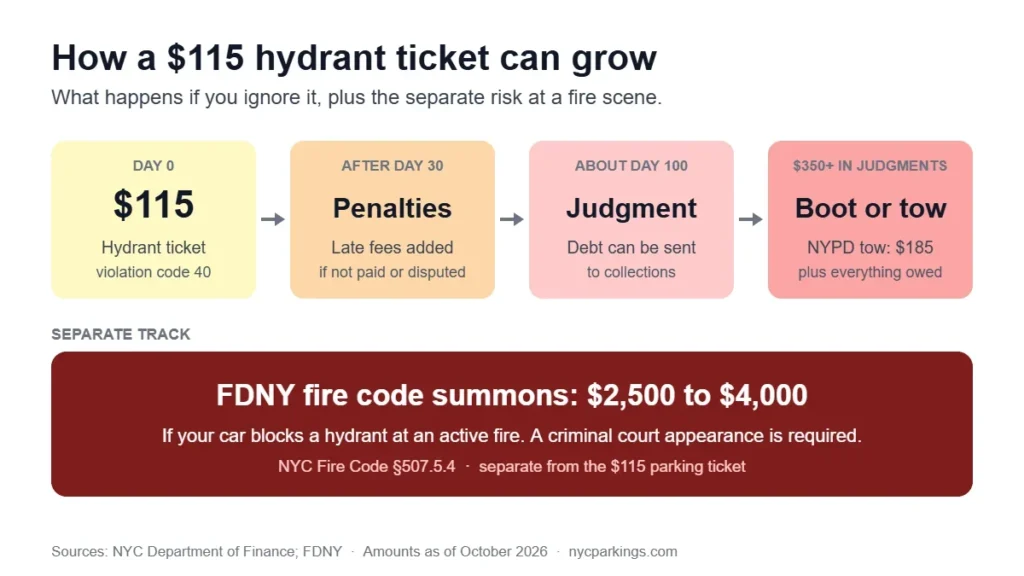
You have 30 days to pay or request a hearing. After that, penalties stack: $10 at 30 days, another $20 at 60 days, and another $30 at 90 days. If you do nothing, the ticket goes into judgment at about 100 days, and the debt can be sent to collections.
Judgments add up fast. Once you owe $350 or more in parking and camera judgments, the city can boot or tow your car. Three ignored hydrant tickets plus penalties can cross that line. Our NYC parking guide walks through the full timeline.
Towing
Every NYC street is a tow-away zone under state law, and the NYPD can tow any illegally parked car. An NYPD tow costs $185, and you still owe the ticket.
The fire code summons
New since 2025
Blocking a hydrant during a fire can now cost far more. NYC Fire Code §507.5.4 makes it illegal to render a hydrant inaccessible or inoperable. The FDNY first used it against a parked car after the February 2025 Bronx fire, with a $4,000 fine.
It did not stay a one-off. By February 2026, officials said 10 criminal summonses had gone to drivers blocking hydrants at active fire scenes, with fines from $2,500 to $4,000. Drivers who receive one must appear in court.
This runs on a separate track from the $115 ticket. The parking ticket goes to the Department of Finance. The fire code summons goes to criminal court.
Why so many drivers get caught
Hydrant tickets are among the most common in the city: about 652,000 in fiscal 2024, according to a City Hall report cited by Streetsblog. The rule is simple. Judging 15 feet on a crowded block is not.
The data also hints at where enforcement lands. FineHero, a company that helps drivers pay and fight tickets, analyzed about 1,000 hydrant tickets from NYC Open Data. It found 62% went to cars fully blocking the hydrant, 97% to cars within 7 feet, and none to cars beyond 11 feet.
Don’t bank on it
Treat that as one company’s sample, not a safe zone. The law still says 15 feet, and an agent can write the ticket at 14.
Some locations have caught drivers again and again:
- Forsyth Street, Lower East Side. A hydrant set back from the road, next to painted parking lines, produced 187 tickets in seven months in 2014. DOT said it would review the markings.
- Ocean Parkway, Windsor Terrace. A hydrant behind an ivy-covered fence drew at least 148 tickets and $17,000 in fines, Patch reported in 2017.
The complaints run the other way too. 311 reports of blocked hydrants rose from 62,126 to 165,021 over six years, with hotspots in parts of Queens and Brooklyn. FDNY officials have cited that rise, and blocked hydrants at fire scenes, in pushing for tougher enforcement.
Should you fight a hydrant ticket or pay it?
Most hydrant tickets are hard to beat because the violation is simple: a judge mainly needs to see that your car was within 15 feet. Fight when you have a real defense. Pay within 30 days when you don’t.
Worth fighting
Defenses that can work
- A missing or defective required element. The agent must record an estimated distance from the hydrant, among other details. A New York parking ticket attorney says a blank distance leads to dismissal. A wrong plate, date, or time can also help.
- Proof you were more than 15 feet away. This takes evidence, not memory: one photo showing the hydrant, your car, and a tape measure between them.
- Proof you met the daylight exception. Dashcam video or a witness showing you never left the driver’s seat before sunset.
- A sign or meter that allowed the spot. Photograph it with the hydrant in the same frame.
Usually a losing argument
Defenses that usually fail
- “I was only there for a minute.”
- “The curb wasn’t painted.” Paint is not required.
- “I didn’t see the hydrant.” A hidden hydrant still counts.
- “Other cars were parked there too.”
- “The agent’s distance estimate was wrong.” The same attorney notes the estimate does not have to be accurate. You still have to prove you were beyond 15 feet.
Build your evidence before you move the car
- Photograph the whole block, then the hydrant and your car together.
- Stretch a tape measure from the hydrant to your nearest bumper and photograph it.
- Capture street signs, the building number, and any sign or meter near the hydrant.
- Keep the original time stamps on every photo.
- Get names and phone numbers from any witnesses.
How to dispute
Request a hearing within 30 days: online, in the NYC Pay or Dispute app, by mail, or in person. Our NYC parking guide covers hearings, appeals, and the city’s free Parking Summons Advocate. If you have no defense, paying on time is the cheapest outcome.
Special situations
Rental cars and out-of-state plates
The rule applies to every car on the street, whatever its plates. A ticket on a rental goes to the rental company first. DOF’s Rental Program lets the company transfer it to you, and your contract may add a fee.
Disability parking permits
The NYC Parking Permit for People with Disabilities (NYC PPPD) lets you park in many No Parking spaces. DOT says it does not cover spots within 15 feet of a hydrant. The New York State hangtag gives no on-street exemption in the city at all.
Delivery drivers and commercial vehicles
Commercial vehicles get some leeway elsewhere, such as limited double parking for quick deliveries. They get none at hydrants, day or night. For legal options, see our guide to truck parking in NYC.
Snow and alternate side suspensions
Snow does not suspend the rule. A hydrant buried in a snowbank is still a hydrant. When the city pauses alternate side parking for snow or holidays, hydrant enforcement continues.
What’s changing, and what isn’t
The fine and the distance have held for years, but both face pressure. Everything below is a proposal unless it says otherwise.
- The 15-foot distance is still law. A state bill to cut it to 10 feet, A4902, was introduced by Assembly Member J. Gary Pretlow in February 2025 and sits in the Assembly Transportation Committee. Near-identical bills have been filed in most sessions since 2009 without passing.
- A $1,000 fine is still only a proposal. City Council Member Joann Ariola, who chairs the Committee on Fire and Emergency Management, has pushed since February 2025 to raise the hydrant fine from $115 to $1,000. She renewed the call in February 2026 after a fatal Elmhurst fire where two hydrants were obstructed. No bill carrying that increase has become law.
- A related bill is in committee. Ariola’s Int. 38 of 2026, introduced on January 29, 2026, would clarify the fines and civil penalties that apply to obstructing a hydrant. It sits with the Committee on Fire and Emergency Management. Her wider package would also have the city mark 15 feet on each side of every hydrant and give firefighters scanners to issue hydrant tickets.
- The fire code summons is already in use. It is not a proposal; see the section on costs above.
As of October 1, 2026, the hydrant fine is still $115 and the distance is still 15 feet. Check the DOF violation code table before relying on any figure here.
If a car keeps blocking the hydrant on your block
Report it to 311 by phone, online, or in the NYC311 app as a blocked hydrant. For a fire or any emergency, call 911. A photo helps, but don’t confront the driver.
A report does not guarantee a ticket. Some residents say their 311 complaints get closed while the car stays put, one reason behind the video-report proposal above.
How to avoid a hydrant ticket
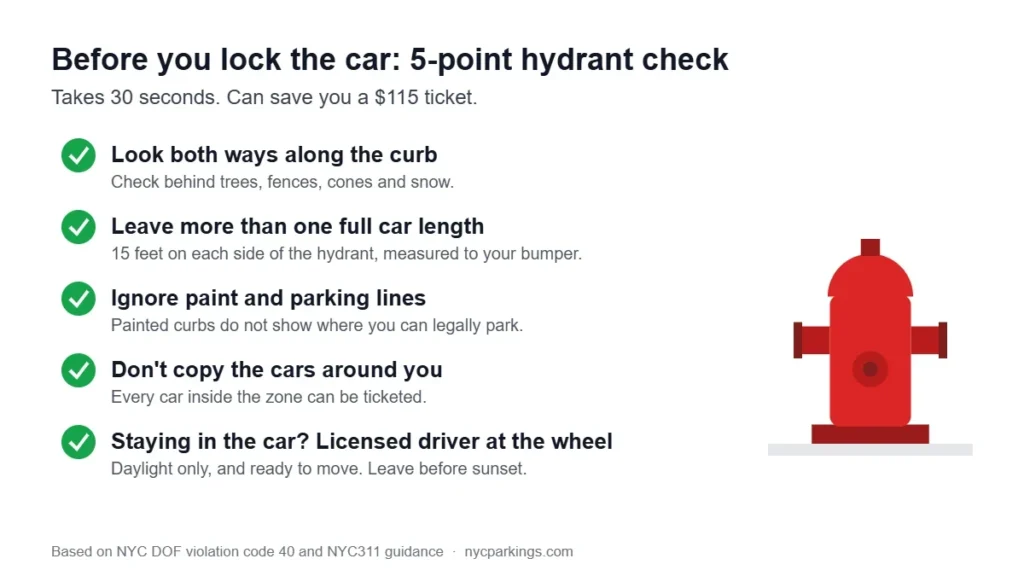
Most hydrant tickets begin with a quick glance and a hopeful guess. A 30-second check before you lock the car is the best protection you have.
- Look both ways along the curb for a hydrant, including behind trees, fences, cones, and snow.
- Leave more than one full car length between the hydrant and your nearest bumper.
- Ignore paint and parking lines as a guide, and judge the distance yourself.
- Don’t copy the cars around you, since each one can be ticketed.
- If you wait in the car near a hydrant, keep a licensed driver at the wheel and leave before sunset.
Skip the hydrant guesswork
Sometimes a block has no legal spot left, and circling eats the time you saved by driving. A garage takes the guesswork out.
Fire hydrant ticket NYC FAQ
How much is a fire hydrant ticket in NYC?
$115 everywhere in the city, including a $15 state surcharge. It is DOF violation code 40.
How far from a fire hydrant can you park in NYC?
At least 15 feet on each side of the hydrant. Measure to the nearest part of your car and leave a margin.
Can you sit in your car at a fire hydrant in NYC?
Yes, but only between sunrise and sunset, in a passenger car, with a licensed driver at the wheel ready to move.
Does the hydrant rule apply at night or on Sundays?
Yes. The 15-foot rule applies around the clock, every day. After sunset, even the daylight exception is gone.
Do fire hydrant tickets add points to your license?
No. It is a parking violation, so it adds no points.
Can I be towed for parking at a hydrant?
Yes. The NYPD can tow any illegally parked car, and a tow adds $185 to what you owe.
Is a standpipe a fire hydrant?
No. NYC311 says standpipes are not hydrants, and you can park in front of one.
Can I beat a ticket if the hydrant was hidden?
Usually not. A hidden hydrant still counts. Check the ticket for a missing distance or other defect instead.
What happens if my car blocks a hydrant during a fire?
Beyond the $115 ticket, the FDNY can issue a fire code summons. Recent fines ran from $2,500 to $4,000, with a court appearance.
Is NYC raising the hydrant fine?
A $1,000 fine was proposed in 2025. As of October 1, 2026, the fine is still $115.